
Most bloggers pick keywords by guessing. They write thousands of words, hit publish, and then wonder why no one finds the post. The reason is simple — they never stopped to analyze keyword competition before writing content.
Competition analysis tells you whether a keyword is winnable before you spend hours creating a blog post. With one quick check, you save time, money, and frustration.
This guide explains how to analyze keyword competition step by step, what signals matter most, and the free tools that make the process easy in 2026.
What Is Keyword Competition Analysis?
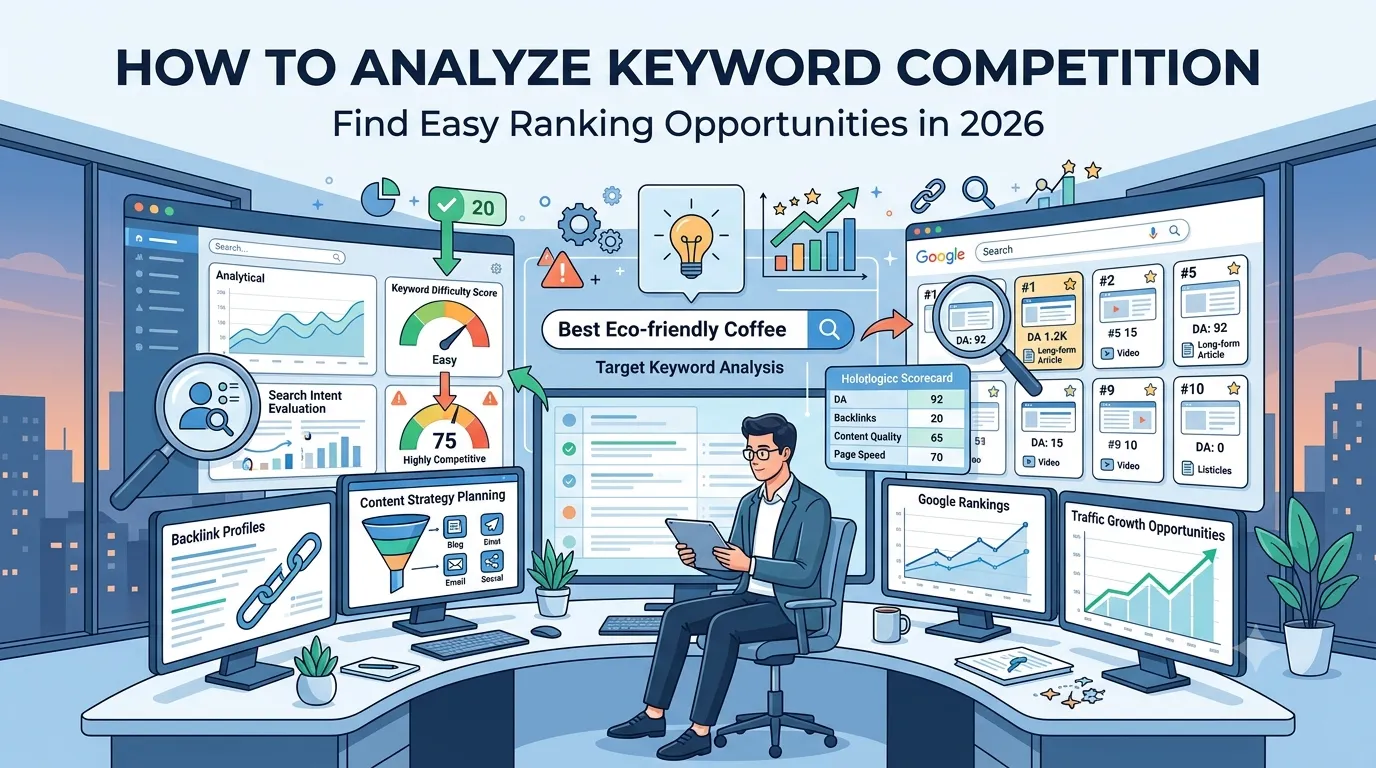
Keyword competition analysis is the process of evaluating how hard it is to rank for a keyword on Google. It looks at the top 10 ranking pages and measures their strength.
So before you write a single word, you know if your site can realistically outrank the current leaders. This single habit separates beginners from pros.
Why You Should Always Analyze Keyword Competition
- Saves you from writing posts that never rank
- Helps you find faster ranking wins
- Reveals weaknesses in existing top results
- Aligns your content with realistic SEO goals
- Boosts long-term ROI from every blog post
Therefore, this small step delivers huge SEO returns.
Key Signals to Check During Keyword Competition Analysis
Focus on these 7 critical signals when reviewing the SERP:
- Domain Authority of top 10 results
- Backlink count of competing URLs
- Content length and depth
- Type of content (guide, list, video, calculator)
- Search intent (informational, commercial, transactional)
- Use of schema markup
- Freshness of top results
Reading these signals together gives you a clear competitive picture.
How to Analyze Keyword Competition in 6 Easy Steps
Step 1 — Check Competition Score Instantly
Use our free Keyword Competition Checker. Enter the keyword and get a quick competition score in seconds.
Step 2 — Open the Google SERP
Search the keyword in incognito mode. Then study the top 10 results carefully.
Step 3 — Note Domain Authority
Check the DA of each result using our Domain Authority Checker. Low average DA means easier rankings.
Step 4 — Inspect Content Quality
Click each result. Look for:
- Thin or outdated content
- Poor formatting
- Missing FAQs and schema
- Weak internal linking
Weak top results = your chance to outrank them.
Step 5 — Compare Backlink Profiles
Use our Competitor Backlinks Checker to view who links to the top pages. If their backlinks come from random forums, easy targets exist.
Step 6 — Decide Yes or No
Combine your signals. If most are favorable, proceed. If not, move to a softer keyword variation or a long tail option.
Search Intent: The Hidden Competition Factor
You can outrank stronger sites just by matching intent better. So always identify intent first:
- Informational: how, what, why
- Commercial: best, top, reviews, comparisons
- Transactional: buy, hire, download
- Navigational: brand or tool names
If you write a transactional page for an informational query, you lose — even with great content.
Red Flags That Tell You a Keyword Is Too Hard
- Top 10 are all DA 80+ giants
- Every result has 3000+ words
- SERP shows mostly ads and shopping results
- People Also Ask shows highly technical queries
- Featured snippet already owns the search
Spotting these early saves you weeks of wasted effort.
Green Flags That Tell You a Keyword Is Winnable
- Top 10 includes blogs under DA 40
- Older articles (3+ years old) still rank
- Forums or Reddit ranking on page 1
- Inconsistent intent in top results
- Few backlinks across competing URLs
These signals scream “easy win” and deserve priority in your content calendar.
How to Beat the Competition After Picking the Right Keyword
- Write longer, deeper, and clearer content
- Add original examples or expert insights
- Use schema with our Schema Generator
- Add FAQs and table-of-contents blocks
- Build a few high-quality backlinks
Pick one or two and apply consistently for steady ranking growth.
Common Keyword Competition Mistakes
- Trusting only one number from one tool
- Skipping the manual SERP review
- Ignoring search intent signals
- Targeting keywords too broad for your niche
- Forgetting to check backlink strength
Avoid these traps and your content stays focused on real wins.
Free Tools for Smart Keyword Competition Analysis
- Keyword Competition Checker — get instant competition score
- Keyword Difficulty Checker — cross-check KD signals
- Domain Authority Checker — measure SERP strength
- Long Tail Keyword Generator — find easier variations
Used together, they form a complete competition analysis stack — and stay free forever.
Final Thoughts
If you take five minutes to analyze keyword competition before writing content, you will save hours of wasted writing later. Smart marketers win by picking better targets — not by writing more words.
Start now with our free Keyword Competition Checker. Pick a keyword, score the SERP, and only write what you can realistically win.
FAQs
Use a free keyword competition checker, then study the top 10 SERP results, their authority, backlinks, and content depth.
It prevents wasted content. You write only when you have a clear chance of ranking on Google’s first page.
A low or medium score is best. Sites under 12 months old should stay below 30 in competition.
Yes. Longer, deeper content usually performs better when competitors publish thin or surface-level posts.
Yes. Match intent better, write deeper content, add schema, and earn a few quality backlinks.
Yes, for most websites. Free tools give plenty of insight when combined with manual SERP reviews.
About 5 to 10 minutes per keyword once you follow a simple, repeatable checklist.