
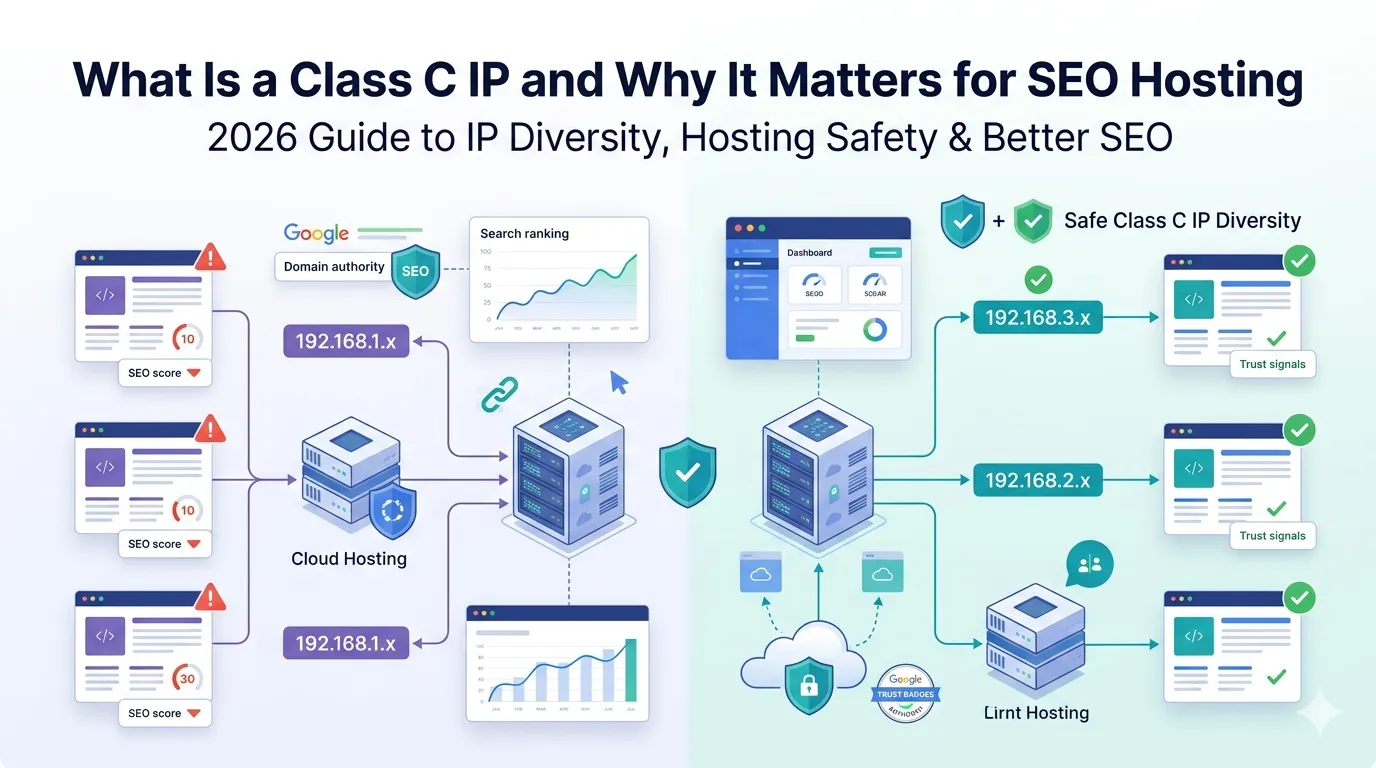
If you run more than one website, hosting choices matter more than you think. Two sites on the same Class C IP can quietly hurt SEO — yet most owners never notice. So understanding Class C IP SEO hosting is critical for anyone serious about long-term rankings.
Google looks at IP patterns to detect unnatural link networks. If your sites all sit on the same Class C IP, Google may treat backlinks between them as low quality.
This guide explains what a Class C IP is, why it matters for SEO, and how to audit your setup in seconds using a free tool.
What Is a Class C IP Address?
An IPv4 address looks like 192.168.1.1. It has four sections (called octets). The third octet — the “C” — is the Class C portion.
So two sites on 192.168.1.1 and 192.168.1.5 share the same Class C block (192.168.1.x). Google treats them as hosted on the same network neighborhood.
Why Class C IP SEO Hosting Matters
- Helps Google detect link networks and PBNs
- Influences perceived backlink quality
- Affects trust signals across multiple sites
- Impacts blacklist contamination risk
- Plays a role in penalty cascades
So one bad neighbor on a shared Class C can drag everyone else down with it.
How Class C IPs Work Inside Hosting
Most shared hosts assign hundreds of websites to the same Class C range. So even unrelated sites end up sharing IPs unintentionally.
Premium hosts and dedicated servers offer unique Class C IPs to protect SEO health.
Why Shared Class C IPs Can Hurt SEO
- Spammy neighbors can affect your reputation
- Cross-linking from same Class C looks unnatural
- Blacklisted IPs may affect your email and indexing
- Limited authority is shared across too many domains
- Server problems impact every site at once
Therefore, choosing the right hosting setup pays off for years.
How to Check Your Class C IP for Free
Step 1 — Open the Class C IP Checker
Use our free Class C IP Checker. Add up to 10 URLs to see which sites share a Class C block.
Step 2 — Review the IP Class Results
The tool highlights sites with matching Class C ranges. So you instantly spot risky setups.
Step 3 — Cross-Check With IP Tools
Confirm details using our Domain to IP and GEO IP Locator.
When Class C IPs Matter the Most
1. Running Multiple Sites
If you own a network of niche sites, mixing Class C IPs prevents Google from spotting unnatural patterns.
2. Linking Between Brands
Internal cross-linking between your own brands gets safer when each brand uses different Class C IPs.
3. Avoiding Bad Neighborhoods
Shared hosting often places you next to spammy domains. Class C diversity helps you avoid guilt by association.
4. Buying Aged or Expired Domains
If you migrate aged domains, make sure they do not land on the same Class C as your main site.
Class C IP Comparison Table
| Setup | Class C Diversity | SEO Safety |
|---|---|---|
| Shared Hosting | Low | Risky |
| VPS Hosting | Medium | Decent |
| Cloud Hosting | High | Strong |
| Multi-Provider Setup | Highest | Best |
So diversifying hosting is one of the smartest long-term SEO investments.
Common Myths About Class C IPs
- “Google ignores Class C IPs” — false; it still tracks patterns
- “Only PBNs need to worry” — false; even normal multi-site setups benefit
- “All shared hosts are unsafe” — partially true; quality varies a lot
- “Cloudflare CDN hides Class C risk” — false; original host still matters
So always audit, even if you use CDNs or cloud hosting.
How to Get Multiple Class C IPs Safely
- Use different hosting providers
- Pick datacenters in different regions
- Choose VPS or cloud plans with dedicated IPs
- Ask your host for dedicated Class C blocks
- Audit setups quarterly with our Class C IP Checker
These small choices keep your sites SEO-safe and easier to scale.
Smart Tools That Pair With Class C Audits
- Class C IP Checker — compare multiple URLs
- Reverse IP Lookup — find sites on same IP
- Blacklist IP Checker — verify reputation
- Domain Hosting Checker — identify hosts
Used together, they protect your network from invisible SEO risks.
Final Thoughts
Class C IP SEO hosting may sound technical, but the rule is simple — diversify your hosting and you protect your SEO. Smart hosting decisions today save big ranking issues tomorrow.
Start now with our free Class C IP Checker. Audit your sites, fix risky overlaps, and build a clean, safe network of websites for 2026.
FAQs
Class C IP SEO hosting is the practice of placing different sites on different Class C IP blocks to avoid SEO risks.
The third octet defines the Class C block. Sites sharing this number are treated as on the same network.
Not always. But shared hosts with many low-quality neighbors can lower trust signals over time.
Use a free Class C IP checker. Add multiple URLs to see which ones share the same Class C block.
No. Even with a CDN, the original hosting Class C still influences SEO and security signals.
Use different hosts, dedicated VPS, or cloud servers in separate regions.
Yes, especially if they cross-link with other sites. Diversifying IPs is always safer for long-term SEO.