
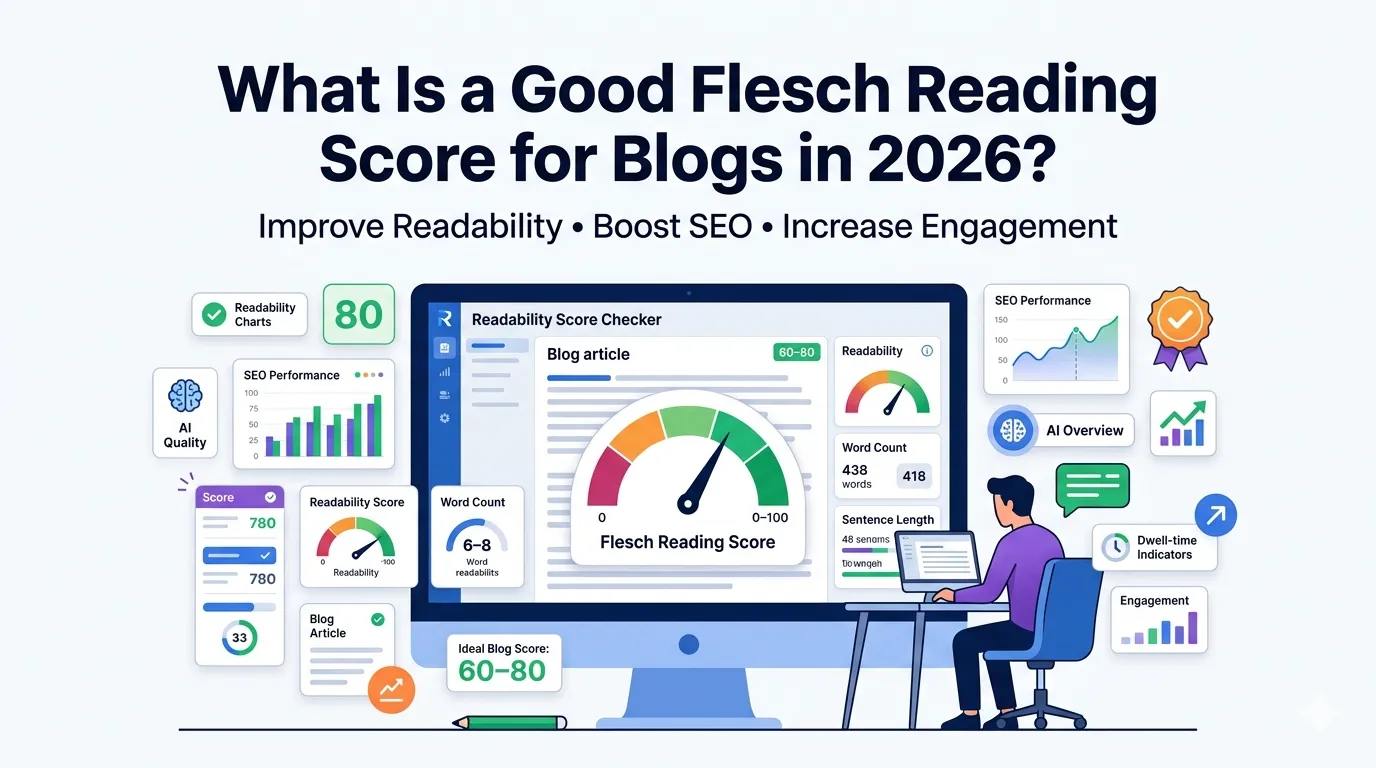
If readers struggle to scan your blog, they leave fast. Google sees that bounce and quietly lowers your rankings. So readability matters — and the most trusted metric is the Flesch score. In 2026, knowing a good Flesch reading score helps you write smarter, rank higher, and convert better.
The Flesch formula scores how easy your text is to read. The higher the number, the friendlier the writing. Even small improvements in readability can dramatically boost dwell time and SEO performance.
This guide explains what a good Flesch reading score is, why it matters in 2026, and how to test and improve your content using a free tool.
What Is the Flesch Reading Score?
The Flesch Reading Ease Score (FRES) is a formula that rates text readability from 0 to 100. Higher scores mean easier reading. It is one of the most widely used readability scores in publishing, SEO, and education.
So a Flesch score helps you measure clarity, scan-ability, and audience comfort fast.
Why Flesch Reading Score Matters in 2026
- Higher readability = longer time on page
- Lower bounce rate strengthens SEO signals
- Improved scan-ability boosts conversions
- AI Overviews favor simple, clear writing
- Accessibility improves for global audiences
Therefore, good readability touches every metric that drives SEO and revenue.
Flesch Reading Score Levels Explained
| Score | Reading Level | Audience |
|---|---|---|
| 90–100 | Very Easy | 5th grade |
| 80–90 | Easy | 6th grade |
| 70–80 | Fairly Easy | 7th grade |
| 60–70 | Standard | 8th–9th grade |
| 50–60 | Fairly Difficult | High school |
| 30–50 | Difficult | College |
| 0–30 | Very Difficult | Advanced academic |
For most blogs, the sweet spot lives between 60 and 80 — simple, clear, but still informative.
What Is a Good Flesch Reading Score for Blogs?
The ideal Flesch reading score for most blogs is 60–80. So that means writing that an 8th to 9th grader can understand easily.
However, the right score depends on your audience:
- Tech and SaaS blogs: 55–70
- Marketing and SEO blogs: 60–75
- Lifestyle and consumer blogs: 70–85
- Academic or legal blogs: 40–60
So match your readability to who you write for.
How to Check Your Flesch Reading Score Free
Step 1 — Open the Readability Score Checker
Use our free Readability Score Checker. Paste your text to get instant Flesch and other readability scores.
Step 2 — Compare With the Ideal Range
Check your number against the 60–80 sweet spot. So you can quickly spot if writing feels too dense or too simple.
Step 3 — Rewrite Where Needed
Use shorter sentences, simpler words, and clean paragraph breaks. Then test again.
Quick Tips to Improve Your Flesch Score
- Aim for 10–20 word sentences
- Use 2–4 line paragraphs
- Pick simpler synonyms (“use” not “utilize”)
- Break long ideas into bullet points
- Use transition words for natural flow
Small tweaks like these often jump your Flesch score by 10–15 points.
Common Readability Mistakes Bloggers Make
- Writing huge wall-of-text paragraphs
- Using academic phrases unnecessarily
- Cramming complex stats without explanation
- Skipping subheadings and lists
- Forgetting voice and conversational tone
So edit your content for humans first, then SEO.
Readability and SEO: The Hidden Connection
- Higher readability = lower bounce rate
- Better scan-ability boosts CTR
- Clear writing fuels featured snippets
- AI Overviews favor cleaner content
- Voice search rewards conversational tone
So readability quietly boosts every layer of organic SEO performance.
Real Examples of Good vs Bad Readability
Too Hard (Flesch 35)
“Utilizing efficacious methodologies, marketers can leverage data-driven paradigms to ameliorate brand authority signals.”
Just Right (Flesch 72)
“Using smart, simple methods, marketers can use data to grow brand trust and SEO authority.”
Notice how the second version reads cleaner, faster, and feels more relatable.
Smart Tools That Pair With Readability Checks
- Readability Score Checker — instant Flesch result
- Keyword Density Checker — keep usage natural
- Heading Tag Analyzer — improve structure
- AI Content Detector — audit tone authenticity
Used together, these tools give you a clean, high-converting blog every time.
Bonus: How to Train Your Brain for Clear Writing
- Read what you write out loud
- Cut every word that does not add value
- Use one main idea per paragraph
- Replace passive voice with active voice
- Edit twice — once for clarity, once for tone
These habits sharpen your style and consistently lift your Flesch score.
Final Thoughts
A good Flesch reading score is one of the simplest signals of strong, reader-friendly writing. In 2026, with SEO and AI rewarding clarity, this score matters more than ever.
Start now with our free Readability Score Checker. Test your blog, tweak your writing, and watch engagement and rankings climb together.
FAQs
For most blogs, a Flesch reading score between 60 and 80 is ideal. It feels easy to read but still informative.
Indirectly, yes. Better readability lowers bounce rate, raises CTR, and helps win featured snippets and AI Overviews.
Use shorter sentences, simpler words, transition phrases, and break text into small paragraphs.
Not always. Some audiences need more depth. Match the score to your audience’s reading expectations.
It means the text is very difficult. Most readers will struggle to scan or understand it.
Yes, but they need editing. AI drafts often need shorter sentences and stronger transitions to score well.
Yes. Most free tools use the same standard formula, giving consistent and reliable results.