
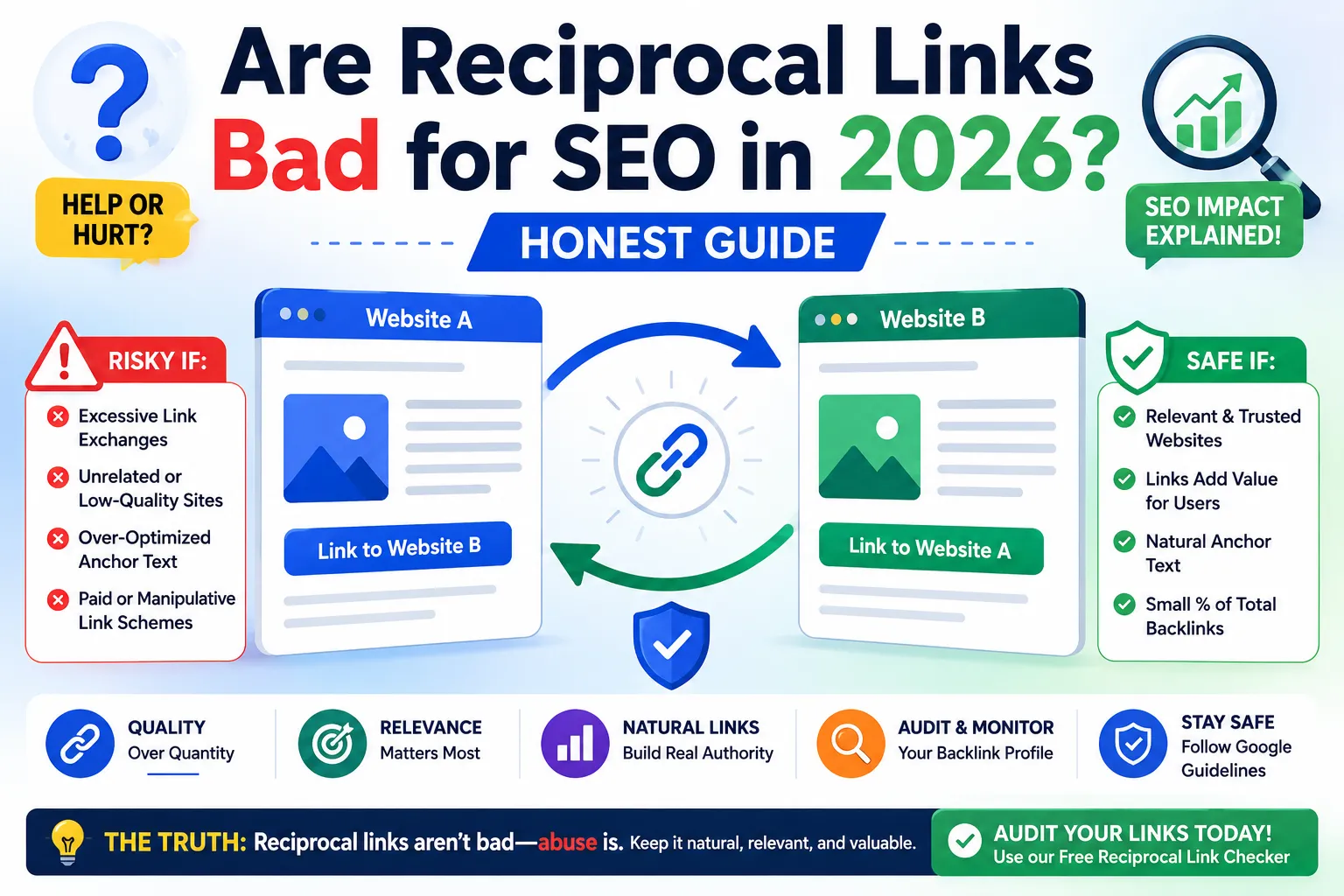
Link building still drives SEO in 2026. Yet one tactic remains controversial: trading backlinks with other websites. So are reciprocal links bad for SEO, or can they still help your rankings? The honest answer surprises most marketers.
Google warns against “excessive” link exchanges. However, natural cross-linking happens every day across blogs, podcasts, and partner brands. The truth lies in balance, not bans.
This guide explains what reciprocal links are, when they hurt or help SEO, and how to audit your link profile with a free tool in 2026.
What Are Reciprocal Links?
Reciprocal links happen when two websites link to each other. So if Site A links to Site B, and Site B links back to Site A, both are reciprocal links.
They show up naturally in partnerships, blogrolls, citations, and content collaborations across the web.
Are Reciprocal Links Bad for SEO in 2026?
The short answer: no, not always. Reciprocal links become bad only when they are excessive, unnatural, or part of a paid scheme.
Google’s guidelines warn against “link exchanges intended to manipulate rankings”. So abuse triggers penalties, but normal partnerships do not.
When Reciprocal Links Are Safe
- Both sites are relevant to each other’s niche
- Links exist for users, not just for SEO
- Anchor text feels natural and varied
- Both pages provide genuine value
- The link count remains a small share of total backlinks
So natural cross-linking between trusted sites continues to be SEO-friendly.
When Reciprocal Links Become Risky
- Two sites exchange 20+ links in short time
- Links sit on hidden or low-quality pages
- Anchor text is over-optimized
- Exchanges happen with unrelated niches
- Linking sites have spammy backlink profiles
Therefore, the risk is not the link — it is the pattern around it.
How Google Detects Bad Reciprocal Links
- Link velocity and timing patterns
- Anchor text similarity across both sites
- Cross-IP and Class C link clusters
- Penguin filters and disavow file matches
- Whether linking pages serve users
So Google rarely punishes single exchanges — but easily catches large networks.
How to Check Reciprocal Links Free
Step 1 — Open Our Reciprocal Link Checker
Use our free Reciprocal Link Checker. Paste your URL and a list of suspected partner sites to see who links back.
Step 2 — Review Quality, Not Quantity
Check if the linking pages add real value. So one strong reciprocal link beats 20 weak ones any day.
Step 3 — Audit Anchor Patterns
Pair the result with our Anchor Text Distribution tool to confirm anchors look natural.
Healthy vs Unhealthy Reciprocal Link Setup
| Signal | Healthy | Unhealthy |
|---|---|---|
| Relevance | Niche-related | Unrelated |
| Anchor Text | Varied + branded | Same keyword everywhere |
| Quantity | Few, natural | Bulk, fast exchange |
| Quality of Pages | High-value content | Thin or hidden pages |
So always check both sides before agreeing to a link swap.
Smart Reciprocal Link Strategy in 2026
- Trade links only with niche-relevant brands
- Avoid mass blogroll or footer exchanges
- Use varied anchor text every time
- Skip dofollow swaps with low-quality sites
- Always link to deep, helpful resources
Done right, reciprocal links still strengthen brand trust and SEO authority.
When to Avoid Reciprocal Links Completely
- Bulk paid link exchange networks
- Sites with toxic backlinks or penalties
- Anonymous or shady link traders
- Hidden directory or PBN setups
- Excessive cross-linking from same Class C IPs
Audit risky setups using our Class C IP Checker and Blacklist IP Checker.
Reciprocal Links vs One-Way Backlinks
| Type | SEO Power | Risk Level |
|---|---|---|
| One-way backlinks | Higher | Lower |
| Natural reciprocal links | Medium | Low |
| Bulk reciprocal exchanges | Low | High |
So aim for mostly one-way links and a few natural exchanges, not the reverse.
How to Audit Your Link Profile Safely
- Check reciprocal links with our Reciprocal Link Checker
- Validate anchor patterns with our Anchor Text Distribution tool
- Spot toxic linking sites with our Blacklist IP Checker
- Compare overall authority via our Domain Authority Checker
- Disavow harmful links in Search Console if needed
Doing this quarterly keeps your SEO clean and growth steady.
Common Reciprocal Link Mistakes
- Trading links with anyone who asks
- Ignoring niche relevance or content quality
- Skipping anchor diversity
- Forgetting to audit partner backlinks
- Bulk swaps for fast wins
Slow, careful link partnerships always outperform reckless exchanges.
Final Thoughts
So, are reciprocal links bad for SEO in 2026? Only when used carelessly. Done with quality and balance, they still build authority and trust safely.
Start now with our free Reciprocal Link Checker. Audit your link profile, fix bad exchanges, and grow rankings the smart, sustainable way.
FAQs
Only when overused or part of paid schemes. Natural, niche-relevant link exchanges remain safe for SEO.
Google bans excessive link exchanges meant to manipulate rankings. Normal, useful partnerships are fine.
Use a free reciprocal link checker. Paste your URL with partner sites to see who links back.
A small share of your total backlinks. As a rule of thumb, keep reciprocal links under 20% of all links.
Slightly. They drive traffic and brand exposure but pass minimal link equity.
Yes, but only when patterns look unnatural or manipulative. Quality exchanges rarely cause issues.
One-way backlinks from authority sites. They carry more SEO value and lower risk.