
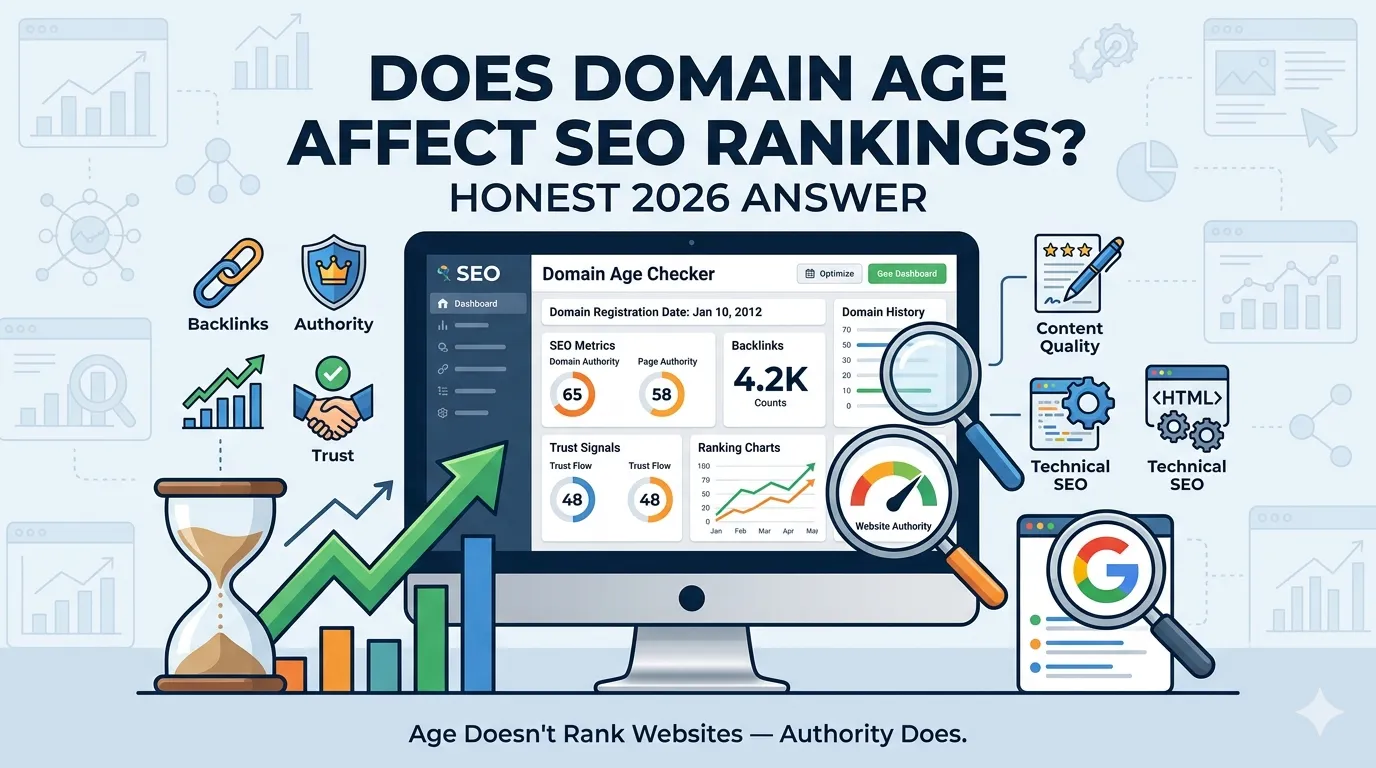
For years, SEOs have debated one big question: does domain age affect SEO rankings? Some swear by aged domains. Others claim they make zero difference. So what’s the honest truth in 2026?
The answer is more nuanced than most blog posts admit. Domain age can help — but only when paired with quality signals. Used the wrong way, it offers no SEO boost at all.
This complete guide explains what domain age actually means, what Google really says, and how to use domain age data to make smarter SEO decisions in 2026.
What Is Domain Age?
Domain age is the time that has passed since a domain was first registered. It does not measure when the website launched — only when the domain was first claimed.
So a 12-year-old domain that has been idle is still “old” — even if no website ever existed on it.
Does Domain Age Affect SEO Rankings? The Honest Answer
No, domain age is not a direct Google ranking factor. Google’s John Mueller has confirmed this many times. However, older domains often rank higher because they have something more valuable:
- Years of backlinks
- Established trust signals
- Brand mentions across the web
- Solid technical SEO foundations
- Mature topical authority
So age itself is not magic — the SEO power those years built up is.
Why People Think Domain Age Helps Rankings
Many SEO myths started in the early 2000s. Back then, older domains often outranked newer ones — but only because they had:
- More backlinks built over time
- Stronger PageRank from old algorithms
- Better historical user data
- Long-standing brand recognition
However, modern Google evaluates each page on its own merit — not its age alone.
When Domain Age Actually Helps SEO
1. Aged Domains With Clean Backlinks
If an aged domain already has high-quality backlinks, it can pass that authority to new content — giving you a faster ranking start.
2. Trust-Building for New Sites
Domain age can signal stability. So established sites earn more user trust — and that lifts click-through and conversion rates.
3. Stronger Brand Power
An older domain often has years of brand mentions and signals. Therefore, Google can connect it to entity-based authority more easily.
4. Surviving “Sandbox” Periods
Some new domains face a slow start (“Google sandbox”). Aged domains often bypass this delay if they have an established footprint.
When Domain Age Does Not Help SEO
- If the aged domain has no backlinks or activity
- If it was used for spam or hacked content
- If the niche changed completely after purchase
- If Google penalized it in the past
So always check history before buying an aged domain.
How to Check Domain Age and History
Step 1 — Use Our Free Domain Age Checker
Visit our free Domain Age Checker. Paste any domain to see registration history, registrar, and age instantly.
Step 2 — Run a Whois Lookup
Cross-check details with our Whois Lookup for ownership, expiry, and registrar info.
Step 3 — Audit Backlinks
Use our Backlinks Checker to inspect link history. If the profile looks spammy, walk away.
Step 4 — Check the Wayback Machine
Look at archive snapshots. So you know what kind of site lived there before.
Domain Age vs Site Authority: Quick Comparison
| Signal | Affects SEO? |
|---|---|
| Domain Age | No (indirect only) |
| Backlink Profile | Yes (strong) |
| Content Quality | Yes (very strong) |
| Brand Mentions | Yes (growing factor) |
| Technical SEO | Yes (foundation) |
So domain age is just one of many signals — and rarely the most important one.
Should You Buy an Aged Domain in 2026?
Yes — if the domain meets these criteria:
- Clean, niche-relevant backlinks
- No spam or hack history
- Consistent past activity
- Strong DA from our Domain Authority Checker
- No active Google penalties
Otherwise, a fresh, clean domain works just as well — and is often cheaper.
How to Make a New Domain Compete With Older Ones
- Publish in-depth, well-structured content
- Build smart backlinks from trusted sites
- Add proper schema markup with our Schema Generator
- Improve speed via our Page Speed Test
- Boost internal linking and topical clusters
Done right, even a brand new domain can outperform a 10-year-old neglected one.
Common Myths About Domain Age
- “Older domains rank better automatically” — false
- “New domains face a strict sandbox” — partially true
- “Aged domains never get penalized” — false
- “Buying an old domain skips SEO work” — false
- “Domain age = trust” — only if backlinks back it up
So always evaluate domains by results, not just age.
Free Tools to Verify Domain Age & History
- Domain Age Checker — instant age and history
- Whois Lookup — ownership and expiry data
- Domain Authority Checker — measure DA
- Backlinks Checker — analyze link profile
Together, these tools cover every angle of domain research in minutes.
Final Thoughts
So, does domain age affect SEO rankings? Not directly. But aged domains often carry years of trust signals that quietly help — if their history stays clean.
Whether you own a new domain or plan to buy an aged one, start with our free Domain Age Checker. Audit history, verify trust, and build a smart, future-proof SEO strategy in 2026.
FAQs
No. Google does not use domain age as a direct ranking factor, but older domains often carry trust signals that help indirectly.
Because they usually have more backlinks, brand mentions, and established SEO foundations built over years.
Yes, only if it has clean backlinks and no spam or penalties. Always audit history before buying.
Yes. With strong content, quality backlinks, and proper SEO, new sites can outperform older ones.
It is a slow-start period for new domains. They may rank lower for a few months until trust builds.
Use a free domain age checker. Paste the domain to see registration date, registrar, and history.
Yes. Penalties stay with the domain, so always audit history before purchase.