
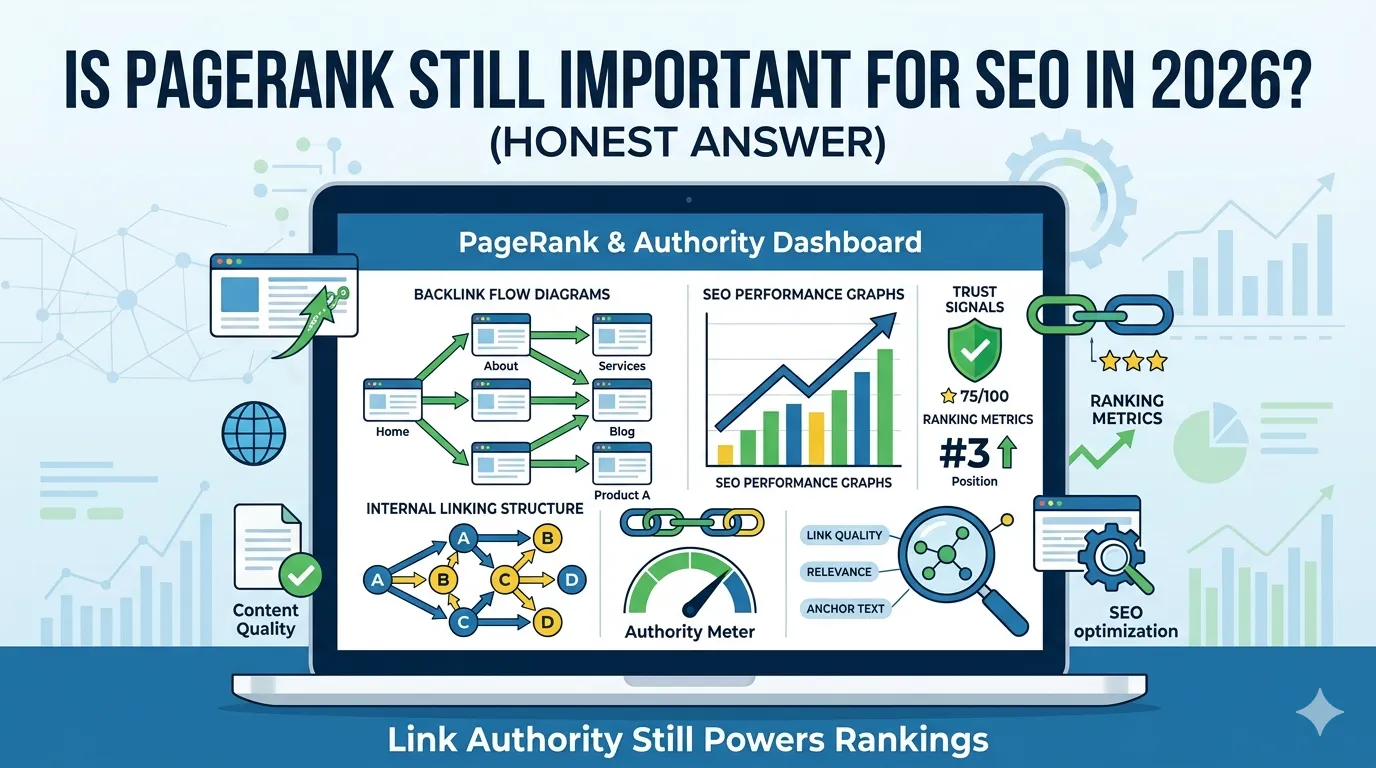
For years, marketers obsessed over Google’s PageRank score. Then Google quietly hid the public number — and many declared it dead. So in 2026, the question keeps coming back: is it still important for SEO?
The honest answer? Yes, more than people realize. It may not be visible as a public score anymore, but Google still uses an internal version every day to rank pages.
This guide explains what it really is today, why it still matters, and how to grow your link authority using free tools — without falling for outdated myths.
What Is PageRank?
PageRank is Google’s original algorithm, created by Larry Page and Sergey Brin in 1996. It measures the quality and quantity of links pointing to a page.
So if many trusted sites link to your page, link authority passes value to it. That value helps your page rank higher in search results.
Did Google kill PageRank?
Google removed the public toolbar PageRank score in 2016, but the algorithm itself never disappeared. It still plays a role in Google’s ranking system.
So while you can’t see any score anymore, Google still evaluates it behind the scenes.
Is PageRank still important for SEO in 2026?
Yes — and here is why:
- Links remain one of the top Google ranking factors
- PageRank still flows through internal and external links
- High-quality backlinks can boost rankings faster than content alone
- Other search engines also use similar link-based signals
- Topical authority depends on internal link structure
So, it’s clear that link authority is still active and continues to influence search results every day.
How PageRank Works Today
Modern PageRank still works on the same idea: a link is a “vote” of trust. But Google has refined the system heavily over the years to:
- Discount spam and paid links
- Reward topical relevance
- Weigh anchor text and context
- Factor in nofollow and sponsored tags
- Include AI-based trust signals
So although the math is now smarter, the core idea remains powerful.
Public PageRank vs Modern PageRank
| Feature | Old Public PageRank | Modern Hidden PageRank |
|---|---|---|
| Public Score | 0–10 toolbar value | Hidden from users |
| Used by Google | Yes | Yes (still active) |
| Updates | Quarterly | Continuous |
| Effect on Rankings | Heavy | Strong |
So the only real change is visibility — not influence.
How to Check PageRank-Style Authority Today
Since Google no longer shares it publicly, marketers use third-party metrics to estimate link authority. The most common include:
- Domain Authority (Moz)
- Page Authority (Moz)
- Domain Rating (Ahrefs)
- Trust Flow and Citation Flow (Majestic)
You can also check our free Google PageRank Checker for a quick authority estimate without any signups.
How to Grow SEO Authority in 2026
Boosting your link authority does not require shady tactics. Follow these proven strategies instead.
1. Earn High-Authority Backlinks
Get featured on trusted sites in your niche. Even one strong backlink can outweigh ten weak ones.
2. Use Smart Internal Linking
Internal links pass PageRank just like external ones. So link from your strong pages to weaker but important ones.
3. Build Topical Authority
Publish many related articles. The more depth you cover, the more trust Google gives your entire domain.
4. Avoid Toxic Links
Use our Blacklist IP Checker and disavow links from spammy domains. PageRank flows fail when toxic links dominate.
5. Fix Broken Pages
Broken pages lose PageRank instantly. Audit using our Broken Link Checker and fix or redirect them.
Common Myths in 2026
“PageRank is dead” — false; it is hidden, not removed
“Backlinks don’t matter anymore” — wrong; they are still an important ranking signal
“More links = better results” — false; quality matters more than quantity
“Nofollow links pass value” — partially true; Google treats them as hints
“You can buy rankings” — false and risky; paid links can lead to penalties
Smart SEO focuses on facts, not myths.
Internal PageRank Flow: The Hidden Goldmine
Most sites waste PageRank by leaving orphan pages or weak internal links. Fix this by:
- Linking from homepage to top money pages
- Adding contextual links inside blog posts
- Removing thin pages or merging them
- Using strong anchor text where natural
- Avoiding too many outbound links per page
This single improvement can lift overall site rankings within weeks.
Free Tools to Track PageRank-Style Authority
- Google PageRank Checker — estimate authority
- Domain Authority Checker — monitor DA growth
- Page Authority Checker — track per-page strength
- Competitor Backlinks Checker — analyze rivals
Used together, these free tools cover everything link authority used to show — and more.
Final Thoughts
So, is PageRank still important in 2026? Absolutely. Google still uses it internally, links still matter for SEO, and internal link flow still influences rankings every day.
Start now with our free checker. Audit your authority, fix weak link flow, and grow steady SEO performance for the long term.
FAQs
Yes. Google still uses it internally, and links remain a key ranking factor for most keywords.
Google removed public scores in 2016 to reduce link spam and manipulation, but the algorithm itself keeps running.
Third-party metrics like Domain Authority, Page Authority, Domain Rating, and Trust Flow help estimate link authority.
Yes. Internal links pass value just like external ones, making them a powerful internal SEO tool.
Google now treats nofollow as a hint. So some link value may still be considered, but with limited weight.
Yes. Free tools like our checker give a quick authority estimate without any signups.
Earn high-quality backlinks, build smart internal links, and remove toxic or broken pages from your site.