
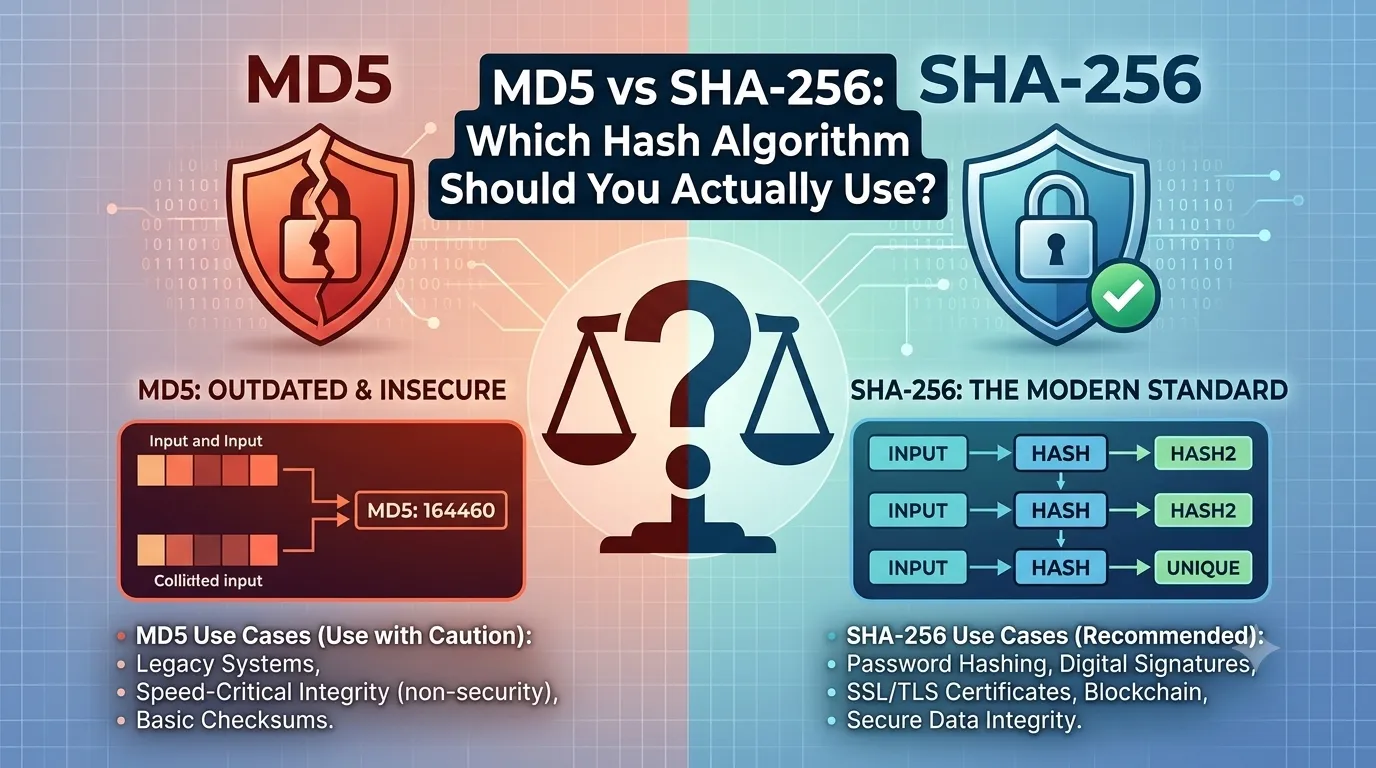
MD5 vs SHA-256 is a question every developer eventually asks. Both produce hash codes, both are easy to use, yet they live in completely different security worlds. Picking the wrong one can quietly weaken your application.
This guide settles MD5 vs SHA-256 with clear use cases, a side-by-side comparison, and friendly explanations. You can experiment instantly with a free MD5 hash generator and SHA-256 hash generator.
The core difference in one line
MD5 is fast but broken for security. SHA-256 is slower but strong and widely trusted. For anything cryptographic, SHA-256 is the safer default in 2026.
MD5 still works for non-security checksums, like verifying a file transferred correctly inside a trusted network. Outside that narrow use, treat MD5 as legacy and reach for SHA-256.
When MD5 is still acceptable
- File integrity checks inside trusted environments
- Detecting accidental data corruption
- Quick deduplication of non-sensitive content
- Legacy systems where SHA-256 is not supported
When you must use SHA-256
- Verifying software downloads from the internet
- Generating tokens for APIs and authentication
- Storing fingerprints of cryptographic keys
- Blockchain and digital signature workflows
- Anything where tampering could cause real harm
Side-by-side comparison
| Property | MD5 | SHA-256 |
|---|---|---|
| Output length | 128 bits (32 hex chars) | 256 bits (64 hex chars) |
| Collision resistance | Broken | Strong |
| Speed | Very fast | Slower |
| Security use | No | Yes |
| Common in 2026 | Legacy checksums | Default cryptographic |
Why MD5 is no longer safe
Researchers proved collision attacks against MD5 years ago. Attackers can create two different inputs that produce the same hash, which breaks any signature or trust assumption built on top.
Modern computers also brute force MD5 quickly. What once took years now takes hours, which is why MD5 should never be used for password hashing or sensitive verification.
Why SHA-256 is the modern default
SHA-256 belongs to the SHA-2 family designed by the NSA and widely vetted. It produces longer hashes with stronger collision resistance and no practical attacks.
Bitcoin, TLS certificates, Git, and most modern code-signing systems use SHA-256. Picking it for new projects aligns with the broader ecosystem.
What about passwords?
Neither MD5 nor SHA-256 is the right choice for passwords. Both are too fast, which helps attackers brute force leaked hashes. Use bcrypt, scrypt, or Argon2 instead.
Pair strong password hashing with a strong password generator and check entries with a password strength checker for a complete security baseline.
Try both in 30 seconds
- Open both hash generators side by side
- Paste the same word and compare output lengths
- Change one letter and watch outputs change completely
- Time how each generator handles a larger file
- Use a percentage calculator to track speed differences
So, which one should you use?
Default to SHA-256 for security work, fall back to MD5 only for legacy checksums where speed matters more than safety. For passwords, use a modern algorithm designed for that job.