
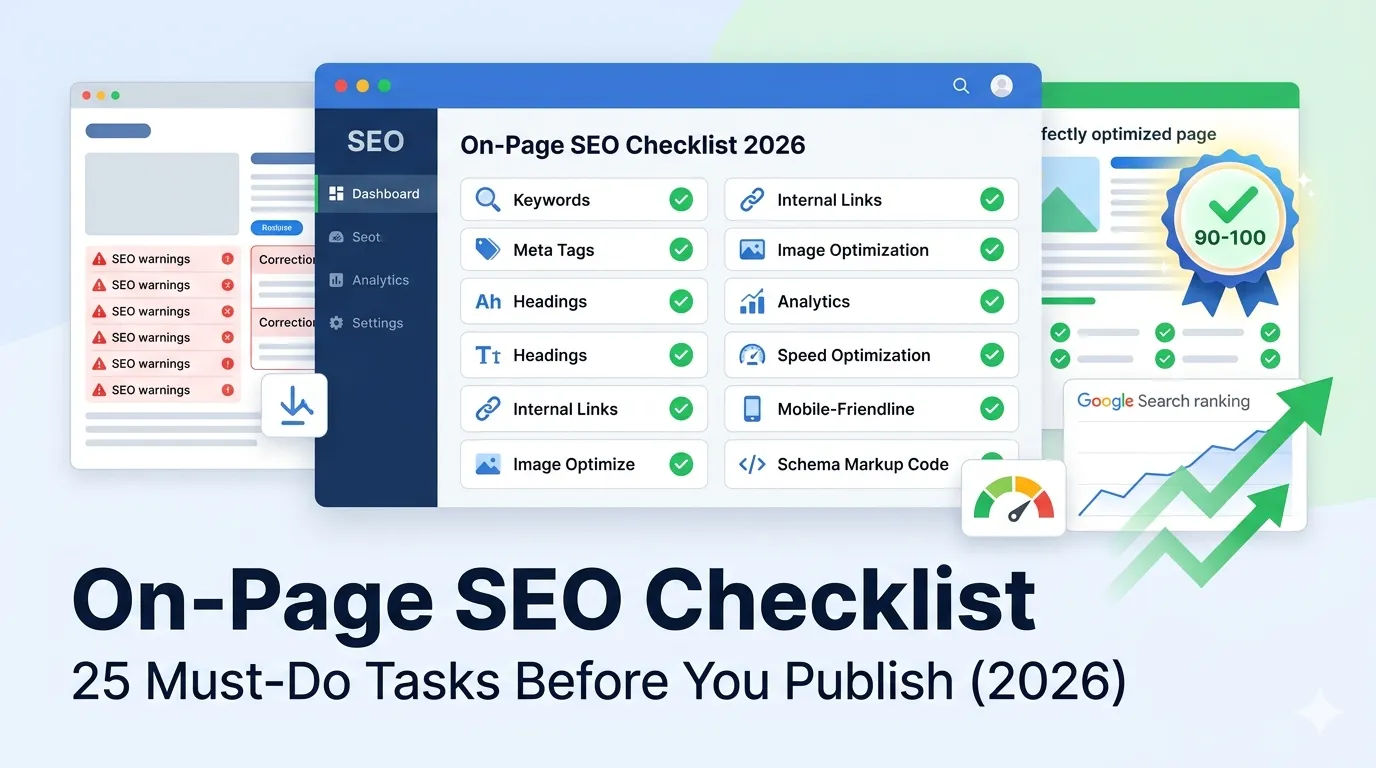
Even great content fails without strong on-page SEO. Yet most marketers forget half the basics before hitting publish. So if you want to rank faster in 2026, this on-page SEO checklist gives you everything you need — step by step.
Each task takes only minutes, but together they shape how Google reads, ranks, and rewards your content. Skipping them costs traffic, conversions, and authority.
This complete on-page SEO checklist walks you through 25 must-do tasks before publishing any blog post, service page, or product page in 2026.
Why an On-Page SEO Checklist Matters
- Prevents missed optimization steps
- Boosts rankings, CTR, and engagement
- Improves Core Web Vitals and UX
- Creates consistent quality across pages
- Reduces editing time per blog post
So with one checklist, every page goes live ready to rank.
25 Must-Do Tasks for Strong On-Page SEO
1. Target One Clear Primary Keyword
Stick to one main keyword per page. Use our Keyword Suggestion Tool to find ideas.
2. Check Keyword Difficulty
Use our Keyword Difficulty Checker to confirm the topic is winnable.
3. Match Search Intent
Look at top 10 SERPs. Then write what the user actually wants.
4. Write a Clear Title (H1)
Include the primary keyword. Keep it under 70 characters.
5. Add a Meta Title (50–60 chars)
Use our Title & Meta Length Checker to validate it.
6. Add a Meta Description (140–160 chars)
Add a clear CTA and your keyword for higher CTR.
7. Optimize URL Slug
Keep it short, lowercase, hyphenated, and keyword-rich.
8. Place Keyword in First 100 Words
So Google and users instantly understand the topic.
9. Use Logical Heading Hierarchy
Audit structure with our Heading Tag Analyzer.
10. Add Semantic Keywords
Sprinkle related terms naturally in H2s and H3s.
11. Keep Keyword Density Healthy
Aim for 0.5%–1.5%. Validate with our Keyword Density Checker.
12. Add Internal Links
Link to 3–5 related blog posts or service pages.
13. Add External Links
Cite authoritative sources where relevant. So Google sees you reference real research.
14. Optimize All Images
Compress with our Image Compressor and add alt text.
15. Audit Alt Text
Check missing alt tags with our Alt Attribute Checker.
16. Use Schema Markup
Add Article, FAQ, or HowTo schema. Generate via our Schema Generator.
17. Improve Readability
Use our Readability Score Checker and target Flesch 60–80.
18. Improve Page Speed
Use our Page Speed Test for LCP, INP, CLS scores.
19. Confirm Mobile-Friendliness
Audit using our Mobile Friendly Test.
20. Add Open Graph Tags
Use our Open Graph Generator for clean social previews.
21. Add FAQ Block
Use 5–7 conversational Q&As. Helps with featured snippets and AI search.
22. Set Canonical Tags Correctly
Self-referencing canonicals avoid duplicate content issues.
23. Use HTTPS and Strong Security Headers
Audit using our SSL Checker and HTTP Headers Checker.
24. Add Internal Linking Targets
Link from older posts to this new page to pass authority instantly.
25. Submit to Google for Indexing
Use Search Console + our Online Ping Website Tool.
Quick On-Page SEO Wins Anyone Can Apply
- Add the keyword to title, slug, and meta title
- Improve mobile readability with shorter paragraphs
- Compress images to under 200 KB
- Add 2–3 contextual internal links
- Validate Yoast/SEO plugin signals
Small upgrades compound into massive ranking gains over months.
On-Page SEO vs Technical SEO vs Off-Page SEO
| SEO Type | Focus |
|---|---|
| On-Page SEO | Content, keywords, structure, meta tags |
| Technical SEO | Speed, indexing, sitemap, schema |
| Off-Page SEO | Backlinks, brand mentions, authority |
So on-page SEO is what you control fully — and where most ranking gains start.
Common On-Page SEO Mistakes to Avoid
- Targeting multiple primary keywords
- Skipping meta titles or descriptions
- Stuffing keywords unnaturally
- Forgetting alt text on images
- Ignoring internal linking opportunities
Each mistake leaks SEO power without you knowing.
Tools That Power This On-Page SEO Checklist
- Website SEO Score Checker
- Keyword Suggestion Tool
- Keyword Density Checker
- Title & Meta Length Checker
- Schema Generator
- Page Speed Test
- Mobile Friendly Test
Use them weekly to keep your on-page SEO sharp and consistent.
Final Thoughts
Following an on-page SEO checklist is the easiest way to keep every blog post strong, structured, and rank-ready. Skip nothing — and SEO becomes predictable, scalable, and stress-free.
Run this checklist before publishing every page in 2026 and pair it with our free Website SEO Score Checker. So you know your content is launch-ready every single time.
FAQs
An on-page SEO checklist is a step-by-step list of optimization tasks done before publishing any page on your site.
It directly affects how Google reads, ranks, and rewards content. So every step adds long-term SEO value.
Matching search intent. Even strong keywords fail if the page does not match what users actually want.
Typically 20–40 minutes once you follow a clear checklist. The more you do it, the faster it gets.
Yes. Clear structure, helpful content, and schema markup all improve visibility in AI Overviews.
Improving meta title and description. They directly boost CTR with very little work needed.
Yes. Refreshing old posts with this checklist often unlocks fast ranking gains.