
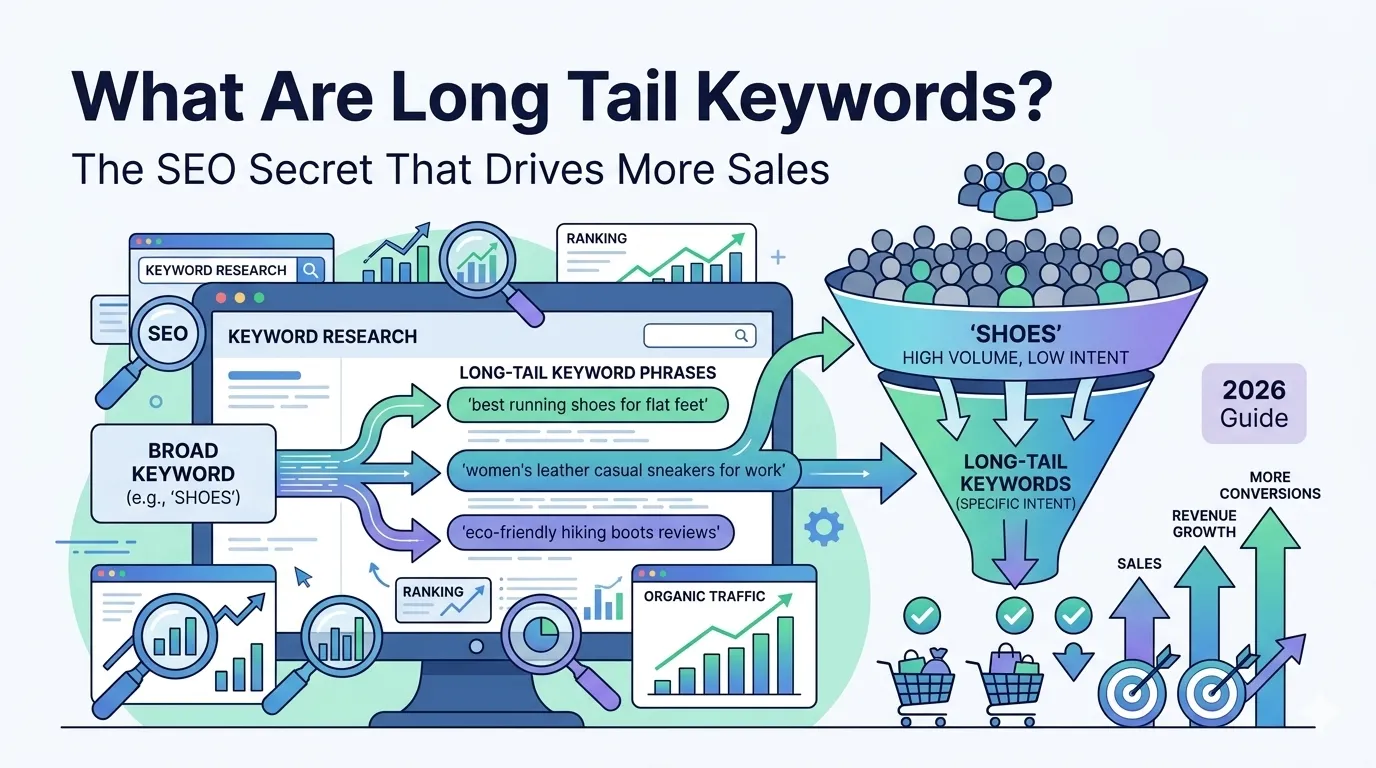
Most beginners chase huge keywords like “shoes” or “SEO” and wonder why they never rank. The secret to faster traffic and real conversions lies elsewhere.
Long tail keywords have lower search volume, but they bring buyers, not just browsers. They are easier to rank, cheaper to target in ads, and convert way better than broad terms.
This guide explains what long tail keywords are, why they drive sales, and how to find dozens of them in seconds using a free tool.
What Are Long Tail Keywords?
Search phrases with three or more words are usually very specific, niche-focused, and aligned with clear user intent.
For example:
- Short keyword: shoes
- Long tail keyword: best running shoes for flat feet women
So while “shoes” is broad and competitive, the longer phrase signals exactly what the user wants to buy.
Why Are They Called “Long Tail”?
The term comes from the famous search demand graph. A few short keywords get massive volume on the left, while millions of specific phrases form the right side of the search demand curve.
Combined, long tail keywords actually drive 70% of all Google searches. Therefore, they hold huge SEO and revenue potential.
Why Specific Search Phrases Drive More Sales
Specific search phrases convert better for many reasons:
- Higher buyer intent
- Less competition
- Better content match
- Lower ad CPC
- More featured snippet opportunities
In short, long tail keywords attract people who know what they want — and are ready to act.
Long Tail vs Short Tail: Quick Comparison
| Feature | Short Tail Keywords | Long Tail Keywords |
|---|---|---|
| Length | 1–2 words | 3+ words |
| Search Volume | High | Low to medium |
| Competition | Very high | Low to medium |
| Intent | Broad | Highly specific |
| Conversion Rate | Low | High |
So while big keywords look impressive, long tail keywords usually deliver better ROI.
Types of Keywords
1. Informational Keywords
Examples: “how to fix slow website”, “what is mobile-first indexing”
2. Commercial Keywords
Examples: “best free SEO audit tool”, “top WordPress backup plugin”
3. Transactional Keywords
Examples: “buy noise cancelling headphones online”, “hire freelance copywriter for SaaS”
4. Navigational Keywords
Examples: “Smart SEO Toolz keyword density checker”, “Yoast plugin login”
Each type fits a different stage of the buyer journey.
How to Find Long Tail Keywords (Free Methods)
You do not need paid tools to discover great long tails. Try these proven methods:
Method 1 — Use Our Free Long Tail Keyword Generator
Visit our free Long Tail Keyword Generator. Enter a seed term and instantly receive dozens of long tail ideas.
Method 2 — Use Google Suggest
Start typing your seed keyword into Google. Note every auto-suggestion. Each one is a real long tail keyword someone is searching for.
Method 3 — Explore “People Also Ask”
Open Google’s “People also ask” box. Click on questions to expand more, then collect them for future blog posts.
Method 4 — Check Reddit and Quora
Niche communities post the exact phrases real users type. Use them as your next long tail blog titles.
Method 5 — Mine Search Console Data
Inside GSC, sort impressions by long phrases. Many gold mines are already hiding in your own data.
How to Use Long Tail Keywords for Sales
Just finding them is not enough. Use them strategically across your content stack:
- Build full blog posts around each long tail keyword
- Add them naturally in product descriptions
- Target high-intent ones with Google Ads
- Use them as H2s and H3s in pillar content
- Cluster them around your money pages
Done right, long tail keywords compound into massive organic traffic over time.
Examples That Convert
- “best free password generator for small business”
- “how to fix mobile-first indexing issues WordPress”
- “affordable SEO tools for startups”
- “convert PDF to editable Word free online”
- “how to check SSL certificate expiry date”
Notice how each phrase screams clear intent — that is the magic of long tails.
Common Long Tail Keyword Mistakes
- Targeting too-broad terms thinking they are long tail
- Forcing keywords unnaturally into content
- Ignoring search intent behind the phrase
- Building one weak blog per keyword instead of clusters
- Skipping competitor research before publishing
Avoiding these mistakes makes every blog post stronger and rank-ready.
Smart Tools to Pair With Keyword Research
- Long Tail Keyword Generator — find ideas fast
- Keyword Density Checker — keep density natural
- Keyword Difficulty Checker — assess competition
- Keyword Position Checker — track rankings
Together, these tools form a complete long tail SEO workflow — and it is all free.
Final Thoughts
Long tail keywords are the secret weapon of smart marketers, bloggers, and small businesses. They drive real sales — without massive budgets or huge backlinks.
So, stop chasing impossible head terms. Start with our free Long Tail Keyword Generator, pick high-intent phrases, and build content that converts in 2026.
FAQs
Long tail keywords are search phrases with three or more words. They are specific, niche-focused, and convert better than broad terms.
They attract users with clear intent. So they convert better than broad keywords with mixed audiences.
Yes. With AI search and voice queries growing, long tail keywords are more important than ever.
Typically 3 to 7 words. The exact length depends on intent and topic depth.
Yes. They have less competition, making them perfect for new websites and small businesses.
Use them in titles, H2s, H3s, intros, meta tags, image alts, and naturally throughout your content.
Yes. They cost less per click and bring more targeted, ready-to-buy traffic.